YoungPEx: The New Generation of Digital for Exascale
Inside YoungPEx, the NumPEx working group that connects young researchers across the French exascale programme — its first General Assembly in Toulouse, its workshops on the environmental impact of HPC and on inequalities in academia, and what comes next.
Community · October 12, 2026 · 7 min read
YoungPEx is the working group of young researchers inside NumPEx, the French research programme for exascale computing. With 53 members on its Discord server and 27 participants at its first General Assembly, it brings together interns, doctoral students, postdocs, engineers, young contract staff and permanent staff — anyone, at any stage, who wants to take part. Its members discuss the questions that matter to their generation: the environmental impact of computing, interdisciplinarity, and the use of AI in scientific research.
NumPEx — "Numérique pour l’Exascale" — was launched in 2023 to develop the skills and infrastructure needed for exascale computing, at the scale of a quintillion (10¹⁸) operations per second. Its research is organised into five targeted projects:
- Exa-MA (PC1) — methods and algorithms for exascale computing
- Exa-SofT (PC2) — software and tools for HPC
- Exa-DoST (PC3) — data-oriented tools and software
- Exa-AToW (PC4) — tools and architectures for large-scale workflows
- Exa-DI (PC5) — development and integration of tools through applications
What is YoungPEx?
Uniting junior researchers in a working group is an innovative initiative within the programme. The goal is to give them room to express their own original ideas: by creating a network of young researchers, new research dynamics emerge across NumPEx. The objectives are to stimulate exchanges between the different targeted projects, to create synergies between researchers, and to prepare future collaborations.
- Meet peers from across the programme, beyond one’s own project and laboratory.
- Discuss scientific challenges so that exchanges and collaborations between centres and projects are easier to start.
- Talk about the academic world — how it works, and what careers look like.
The group discusses whatever its members want to bring: the environmental impact of research, the societal impact and acceptability of HPC, social and gender inequalities in academia, academic life and careers, and AI.
The working group held a kick-off session during the NumPEx General Assembly in March, ran its first General Assembly in Toulouse in November, took part in the Trans’Numériques events in Rennes, and published an overview in the Matapli review.
The first General Assembly, in Toulouse
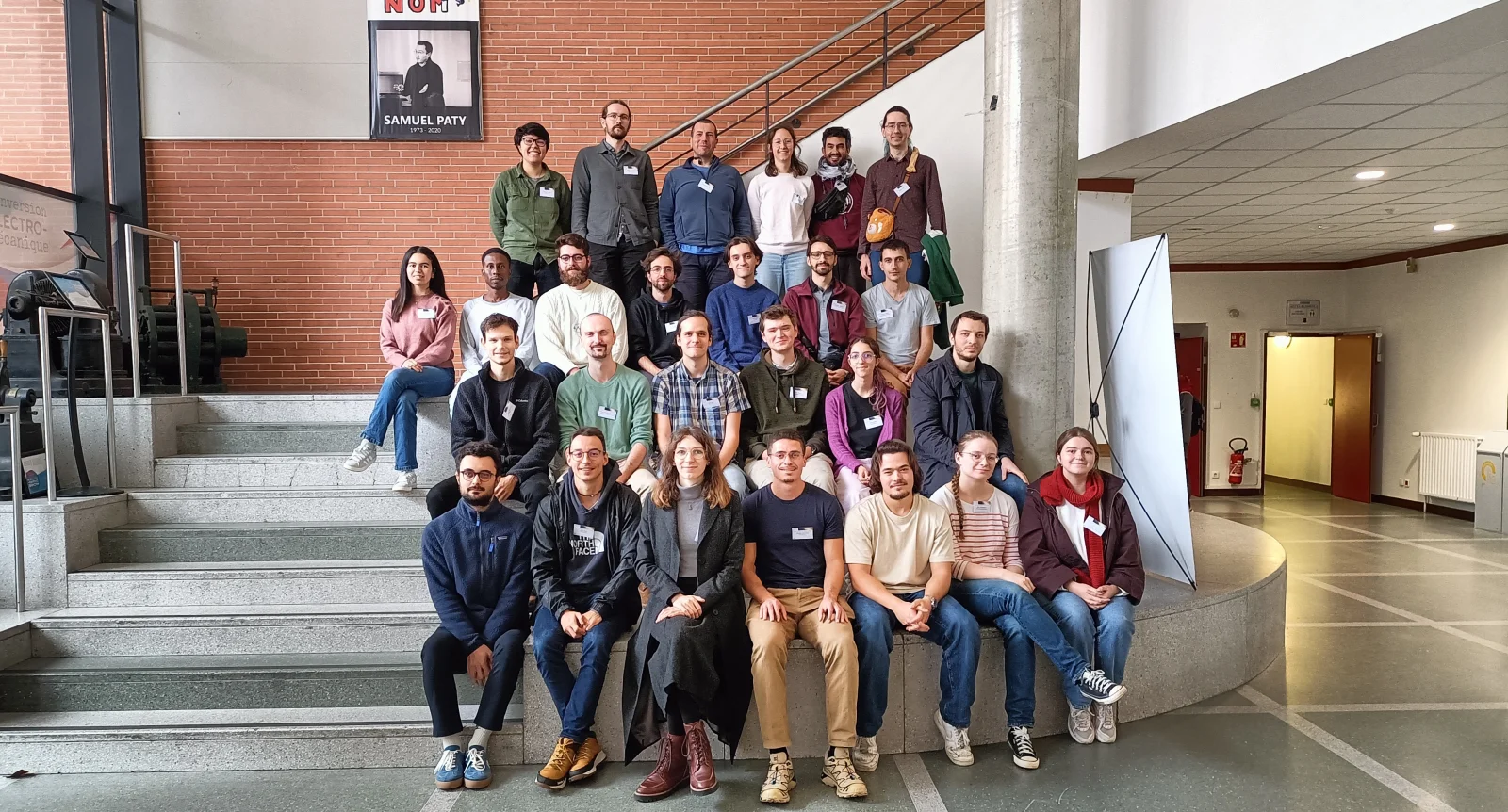
The group’s main event of 2025 was its first General Assembly. Twenty-seven young researchers from laboratories across France met from 12 to 14 November 2025 at INP-ENSEEIHT in Toulouse. Across four half-days, the programme combined a workshop on the environmental impact of HPC, a general assembly to discuss the group’s next actions, and a workshop on social and gender inequalities in research.
The environmental impact of HPC
The workshop was led by Georges Da Costa (IRIT, Exa-SofT), professor of computer science at the Université de Toulouse, answering a strong interest among young researchers in the environmental impact of their work.
The introduction made clear that energy production and consumption are a collective question rather than an individual one. French energy consumption and emissions are tied to those of its neighbours: European energy resources form an interconnected network. The emissions attributed to a person are not limited to their direct consumption — they include those generated by the public services they benefit from, by imports, and by digital uses such as cloud services, whose carbon footprint is often underestimated. Geopolitical issues also weigh on the Internet itself: strategic infrastructure such as submarine cables conditions digital sovereignty and the security of states, and the dependence on lithium produced outside Europe illustrates the vulnerability of supply chains for materials critical to energy-transition technologies.
Software is not exempt. The growing complexity of applications makes global optimisation of energy consumption harder, while the absence of a clear architecture generates dead code and superfluous costs. Removing obsolete features and documenting code rigorously allows it to be "recycled" — rewritten more efficiently, which reduces both debugging time and the resources consumed by CI/CD pipelines. The conclusion was that a systemic approach is required: optimise resources, secure infrastructure, and rethink software design for a more sustainable future.
Hands-on: measuring energy consumption
Doctoral students in the programme working on the energy consumption of supercomputers sparked real curiosity among their peers, so Georges Da Costa continued the workshop with a presentation of tools to measure the energy consumption of computations in computing centres.
MOJITO/S is a set of open-source tools for monitoring energy and network usage at the operating-system level, available on gitlab.irit.fr. The session also recalled that the French scientific community has the Grid’5000 environment (grid5000.fr) to carry out research in distributed parallel computing, HPC, Big Data and AI — a set of experimental platforms offering great freedom to users, in particular essential access to the wattmeters attached to computing resources.
Mathis Certenais closed the workshop with a presentation of Impacts-HPC, a tool developed in the Exa-AToW project with the EcoInfo research group. It is a Python library that evaluates the impact of use for the extraction, production and distribution phases, with a full life-cycle assessment to come. The tool computes environmental impact along three criteria: global warming potential, abiotic resource depletion, and primary energy consumption. Impacts-HPC complements the indicators provided by the DARI web portal used to allocate resources on the IDRIS, CINES and TGCC HPC centers; the portal’s information relies on the method of the Labos 1point5 collective.
Questions and ideas from the participants
The workshop ended with the participants’ own questions about HPC use — questions the tools above could help answer:
- Getting metrics on the environmental impact of the simulations carried out — which depends on where the electricity comes from at the moment of execution, nuclear or coal for instance — through meaningful information such as financial cost.
- Having an idea of how to size jobs according to actual needs (number of nodes, and so on).
- Finding a balance between computational cost and the impact of the research, with interdisciplinary expert advice.
The slides used during the workshop are available on the NumPEx website (numpex.org).
Community activities
Feedback from YoungPEx on the use of LLMs for coding
For the 55th edition of the ORAP forum, on the theme "IA générative pour le HPC : une nouvelle rupture ?", the YoungPEx committee surveyed the working group about its use of LLMs in programming. The results were presented on 28 November 2025, and the session is described on orap.irisa.fr.
A 12-question questionnaire, sent by email, showed that 18 of 25 respondents use these models. Among the 18 users, 16 use GPT models and 72% combine models from different providers; half use them daily, mainly to understand, generate and debug code. Of those 18, 16 feel that LLMs improve their productivity and 7 report an improvement in their programming skills. Satisfaction with the quality of the generated code is more mixed: only 7 are satisfied, 6 find it average and 4 insufficient. The main challenges identified are inconsistent results and a lack of contextual understanding.
Excerpt from the YoungPEx presentation on the use of LLMs for coding: the models used by members.
Excerpt from the YoungPEx presentation on the use of LLMs for coding: the challenges reported by members.
Social and gender inequalities in academia
Long confined to a narrow social circle, academic research has gradually opened up, notably to women and gender minorities. Aware that there is still a way to go, the group dedicated a morning to raising awareness of social and gender inequalities, hoping to contribute, at its own scale, to a more inclusive workplace.
Yasmina Asso presented the results of studies by the Observatoire des inégalités (inegalites.fr). The organisation offers an adaptation of the famous Monopoly game that makes real inequalities tangible: it is built on data from its studies of inequalities in France, linked in particular to gender, disability, resources and origins. The activity closed with a collective discussion of what participants had observed, and of how economic rules shape social positions and starting inequalities.
A session of the Monopoly of inequalities during the General Assembly.
The exchanges then turned to academia — mathematics and computer science in particular. Julie Lesthelle (Université de Bordeaux) presented her master’s thesis, "Les études en licence de mathématiques sous le prisme du genre", grounding the definition of the leaky pipeline: minorities are less represented in positions of responsibility than in others — fewer research directors than research fellows, for instance.
Her work highlights two brakes on young women in science: the fear of making mistakes — in fields where experimentation and voicing doubts are essential to learning — and gendered socialisation, such as later contact with computer science than male peers. Teachers play a decisive role: reading students’ body language lets them value error as a constructive step and anticipate implicit questions. For the young researchers present, the fight against inequalities is a collective responsibility that requires continuous mobilisation.
Julie Lesthelle speaking in front of YoungPEx.
Publications
YoungPEx also writes. The group contributed an overview to MATAPLI, the newsletter of the Société de Mathématiques Appliquées et Industrielles, in issue 139.
The YoungPEx overview in MATAPLI, issue 139.
A poster presenting the group — its context and issues, its objectives, and its current advances — was displayed at the Trans’Numériques 2026 event, from 2 to 5 February 2026.
Learn more
The official YoungPEx page is at numpex.org/youngpex, and the first General Assembly has its own write-up and slides at numpex.org/the-first-youngpex-general-meeting.