International Hackathon for Radio Astronomy
A research event bringing together computer scientists and astrophysicists from France, England, and South Africa to address the shared technical challenges of radio astronomical data.
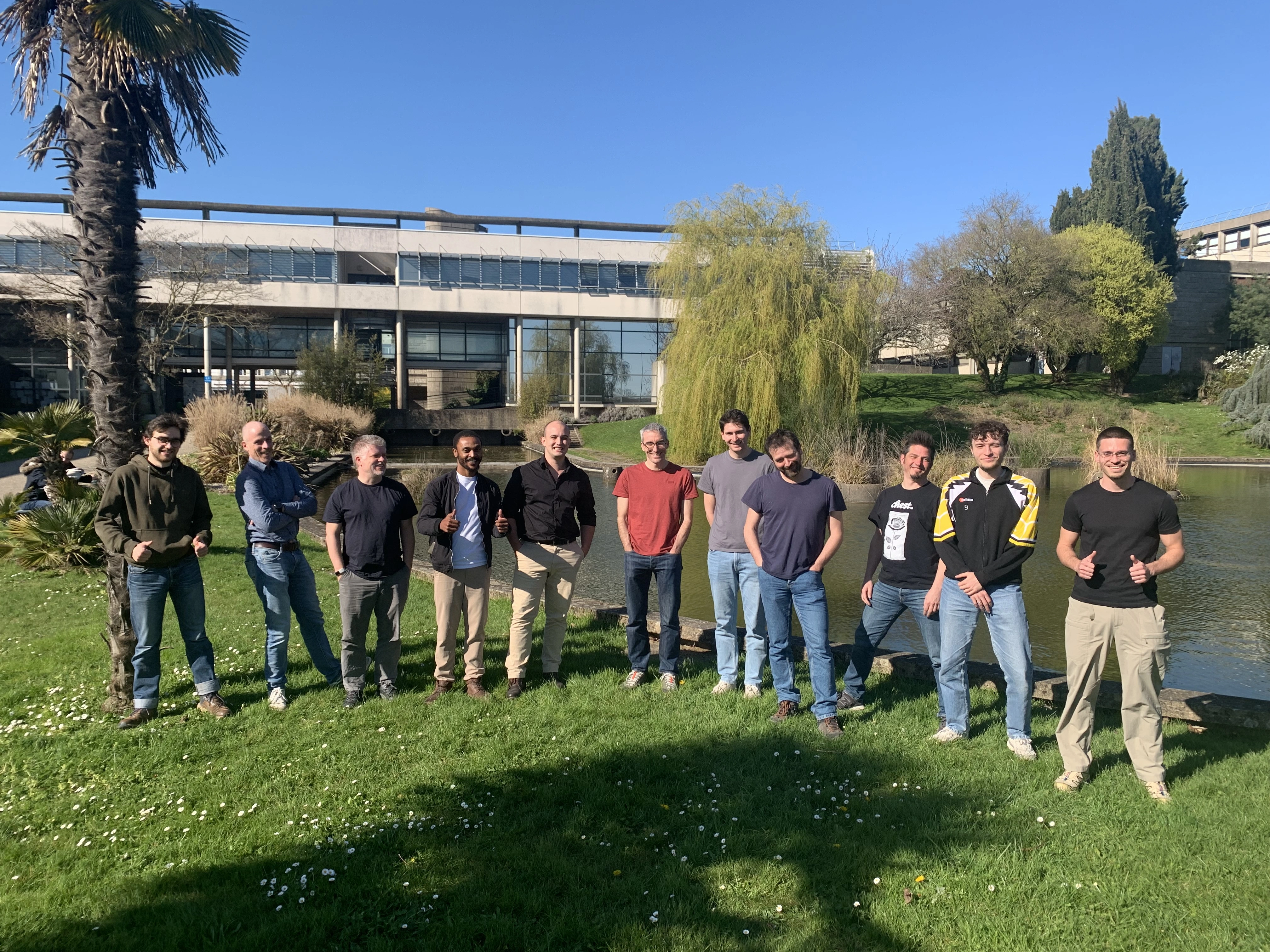
Collaboration · April 1, 2026 · 1 min read
Scientific software becomes more useful when the people who build infrastructure and the people who interpret astronomical data can work on the same problems together.
What are the goals of this hackathon?
The international hackathon in Rennes created space for that collaboration: participants worked during one week to create a participatory research network called RIMS Network and to continue work on the DDF Pipeline data-processing software.
RIMS Network is a distributed storage system that hosts dynamic spectra and their metadata for studying rare events. It enables collaborative data production and can be accessed by users via a web service.
For the DDF Pipeline, we worked on portability of the parallel version: it is now installed and running on the French supercomputers Jean Zay hosted at the Institut du Développement et des Ressources en Informatique Scientifique (IDRIS), Adastra at the Centre Informatique National de l`Enseignement Supérieur (CINES), at the University of Hertfordshire (UK), and with our industry partner Bull.
What is the benefit of this international collaboration?
These technical events are crucial for bringing our community together to align on shared goals and turn them into reality. During this hackathon, we successfully validated the deployment of the DDF Pipeline on the supercomputers of all participating partners, finalizing this stable version so we can now focus on developing new features. For RIMS, this international gathering allowed us to collectively finalize the general distributed architecture across France, South Africa, and the UK, as well as agree on usage conditions and deliver a proof-of-concept to validate the core idea.