How I Created an AI Lab to Launch My Open-Source Virtual Running Coach
In this side-project blog, Mathis Certenais explains how a knee injury and a folder of GPS files became an open-source virtual running coach — and why the real product is the method behind it: one orchestrator, eight specialist agents, and a test suite that refuses to let a number lie.
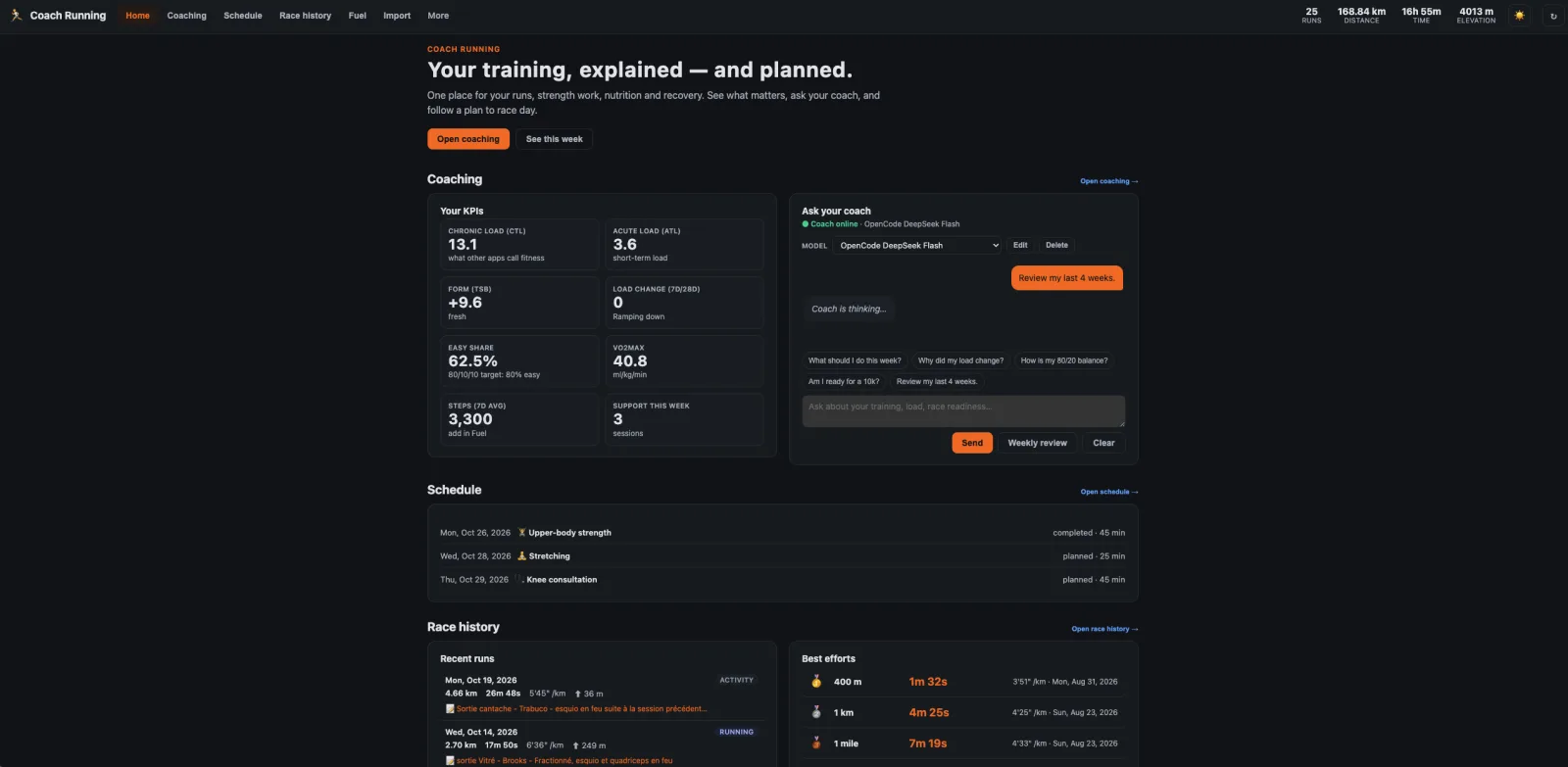
Side project · October 26, 2026 · 7 min read
The interview
You’re a runner first. Where does this start?
I’m an amateur runner. I started like most people: running became fashionable, so I tried it. What kept me going is how practical it is — you put on your shoes, you walk out of your door, and you run.
I increased the distance gradually, and then I hit a wall at 10 km: pain. A physiotherapist for exercises, an X-ray, an ultrasound, a sports doctor, and finally a diagnosis — femoropatellar syndrome. Nothing dramatic, but enough to understand that I had to pay attention to what I was doing.
So you started collecting data. What went wrong?
I began recording my runs with OpenTracks, an open-source mobile sport tracker that respects your privacy. The files piled up, and I had neither the time nor the knowledge to analyse them.
A GPS file is not an insight. It is a very precise record of something I did not understand.
What did you want instead?
A virtual coach grounded in the literature, computing my own indicators from my own data: VO2max, intensity distribution, training load, injury signals. Then I enriched it with what actually surrounds a run — nutrition, a stretching and strength programme, and daily step count, which matters a lot in my case: the sedentary days are exactly when the knee complains.
And AI on top, to make that data speak: training strategy, stretching for race preparation, race-time predictions.
So what does the coach actually hand a physiotherapist?
One exported report, generated locally from the database, covering the ten weeks to 19 October 2026: 25 runs, 168.8 km, 16 h 55 of moving time, 4 013 m of elevation. It carries the load figures — chronic load 12.8, acute load 3.0, form 9.8 — the intensity distribution against the 80/10/10 target, what I reported about pain, the strength and mobility sessions with their perceived effort, and the mileage on each pair of shoes.
That is the point of the export. In a consultation I bring what I remember from the day before, and nobody remembers ten weeks of training. The report brings the numbers, and the felt effort I logged session by session as it was felt — not reconstructed three weeks later around a knee that hurts today. The physiotherapist and I read the same file.
The report for the physiotherapist, covering 10 August to 19 October 2026 and generated on 27 October 2026. It ends on the caveat that matters: correlation is not causation — these are patterns to discuss with a professional, not a diagnosis.
You keep saying “the sensor is the watch, the phone is the transport, the laptop is the brain”. What does that mean?
It is the architecture, in one sentence.
The watch records. The phone moves the file. The laptop does the thinking — and it keeps the data. No account, no cloud, no telemetry: the application runs on 127.0.0.1, reads files from a folder, and writes to a SQLite database next to it.
I was looking for performance. But performance starts with analysing what happens on the ground, and that analysis had to belong to me.
What is an “AI lab”, concretely?
Not a model. A way of working.
The environment is OpenCode. In it, one orchestrator talks to me, plans, and dispatches. Around it, eight specialists with disjoint ownership: developer, architect, UI, quality control, scientist, marketing, security, writer. They load the engineering skills from mattpocock/skills when a task matches one — grilling before a design decision, test-driven development, code review against a written standard.
The part that makes it an organisation rather than a prompt collection is the permissions. The quality agent cannot edit files. Neither can the architect or the security reviewer. A reviewer that can fix what it finds stops being a reviewer.
Why specialists instead of one large prompt?
Because a single agent will do everything, badly, and never tell you.
Two agents that do not talk to each other produce two vocabularies, two data models and two visual languages. That is the failure mode I wanted to design out: the scientist disagrees with the marketer, the quality agent disagrees with the developer, and I arbitrate. That disagreement is the product.
What is open source, and what do you sell?
The code is AGPL-3.0 on GitHub. It is free, it runs on your machine, and it will stay that way.
What I sell is not the binary. It is the capacity to take an idea to a working proof of concept: the agent organisation, the research discipline, the tests, the documentation, the release. This application is the case study; your project is the next one.
How can you manage an AI lab, economically?
Everything an agent does costs context, so the first management decision is not which model to use. It is what you put in front of it.
Start with the price, because it decides the architecture. On OpenCode Zen, per million tokens:
- DeepSeek V4.1 Flash — input $0.30, output $1.20, cache read $0.006.
- DeepSeek V4 Pro — input $1.74, output $3.48, cache read $0.145.
A realistic session — 40 turns, about 40k tokens of context, 1k of output per turn — sends roughly 1.6 million input tokens:
- Flash — $0.53 with no cache; $0.10 at 90% cached.
- Pro — $2.92 with no cache; $0.63 at 90% cached.
Read the two scenarios again. An input token costs $0.30 per million when the model has never seen it, and $0.006 when it comes from the cache: fifty times less. The number that matters is therefore not the price of the model, it is the number of cache misses. Anything that rewrites the beginning of the conversation — editing the system prompt, reordering the project instructions, reloading a skill mid-task — throws the cache away and silently moves you from the cached scenario to the uncached one.
So the rule is: Flash for the worker, Pro for the architect. Ten cents for the session that writes the tests, sixty for the one that decides the structure.
The answer to “how do you run this” is four tools, each doing one thing.
herdr is the building. A terminal multiplexer made for agents: panes, tabs, sessions, one git worktree per experiment, and a sidebar that says which agent is working, idle or blocked. It does not run the AI; it gives it a place to run.
OpenCode is the team. One orchestrator and eight native sub-agents — the developer, architect, UI, quality, scientist, marketing, security and writer described above. It is where the work is decomposed.
Pi is the lone contractor. A minimal harness: short system prompt, few tools, no sub-agents, cheap to run. That minimalism is the point — it is where I want a precise, bounded task and nothing else in the context.
Fresh is my desk. A terminal editor, in a pane next to the agents, for reading the diff and correcting by hand.
That is the whole management model: spend the expensive model on the decisions, the cheap one on the execution, and keep the context stable enough that the cache keeps paying. Everything else is ergonomics.
What’s next?
Two things, in order.
Validation. The injury module has a base rate, an export for a physiotherapist and a place to record their verdict — but it has never been tested against one real episode and one clinician’s reading. That is the next hour of work, and it is not code.
Reach. The app is import-only by design: the watch records, the app thinks. Making that transport disappear is not really a feature problem. It is the problem I work on every day in my thesis — data logistics: data is produced at the edge, it has to reach a place where it can be processed, with no central authority, no silent duplication and a clear answer to who owns the copy. Here the instrument is a watch and the compute is a laptop. At IRISA it is a radio telescope and a supercomputer, and the questions are identical: what moves, when does it move, what is copied twice, and what happens when a transfer dies halfway.
The rest is already in the repository: an open-source virtual running coach, 324 tests, seven architecture decisions, ten research notes with citations, and eleven read-only tools the coach can call to answer questions about my own data.
That is the direction I want to take this project — not more features, but the same logistics reasoning applied at a smaller scale, in the open. The research behind it is here: mathiscertenais.com/research.